
AIONE - AI Intent Collaboration Agent
AIONE is an AI Intent Collaboration Agent designed to turn ambiguous user intent into structured, controllable AI instructions through transparent human-AI collaboration.
Hello, this is mini-me, let me help you to know more about AIONE
1. The Problem: Why Prompting Breaks Down
Generative models are no longer the bottleneck. Human expression is. Users often know exactly what they want, but struggle to translate that intent into explicit instructions AI can understand. AIONE exists to bridge this gap—transforming human intent into structured, interpretable instructions while keeping people in control of the process.
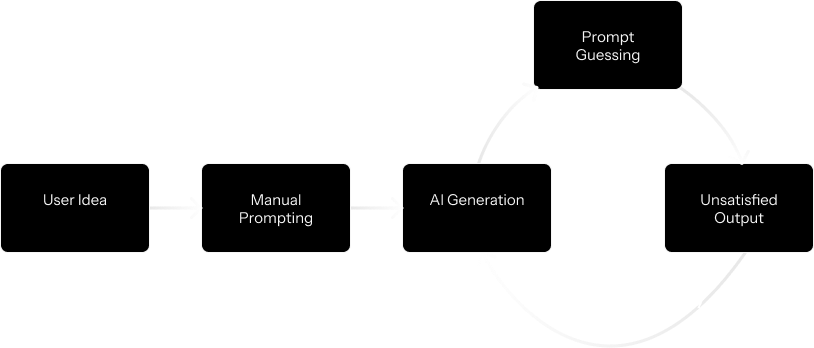
Existing Creative Workflow:People already use AI, but prompting frequently breaks down.
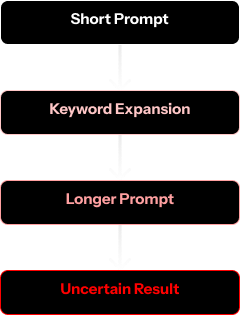
The market is not lacking prompt generators. Most existing solutions simply expand user keywords into longer, more elaborate prompts. While the output may appear more sophisticated, it often fails to capture the user's actual intent. The result is not necessarily a better prompt—just a longer one.
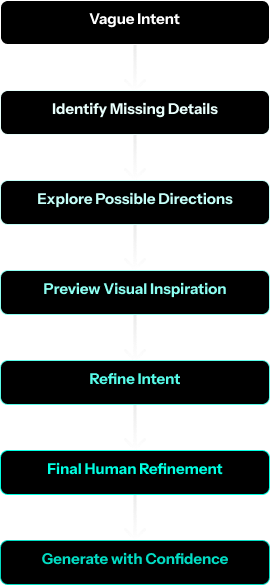
Instead of simply expanding keywords, AIONE helps users clarify, structure, and refine their intent. Guided recommendations, visual references, version control, and human-in-the-loop collaboration ensure that prompts remain aligned with user goals.
2. System Architecture: How AIONE Works
From Human Intent → Structured Understanding → Guided Collaboration → Generation-Ready Prompt
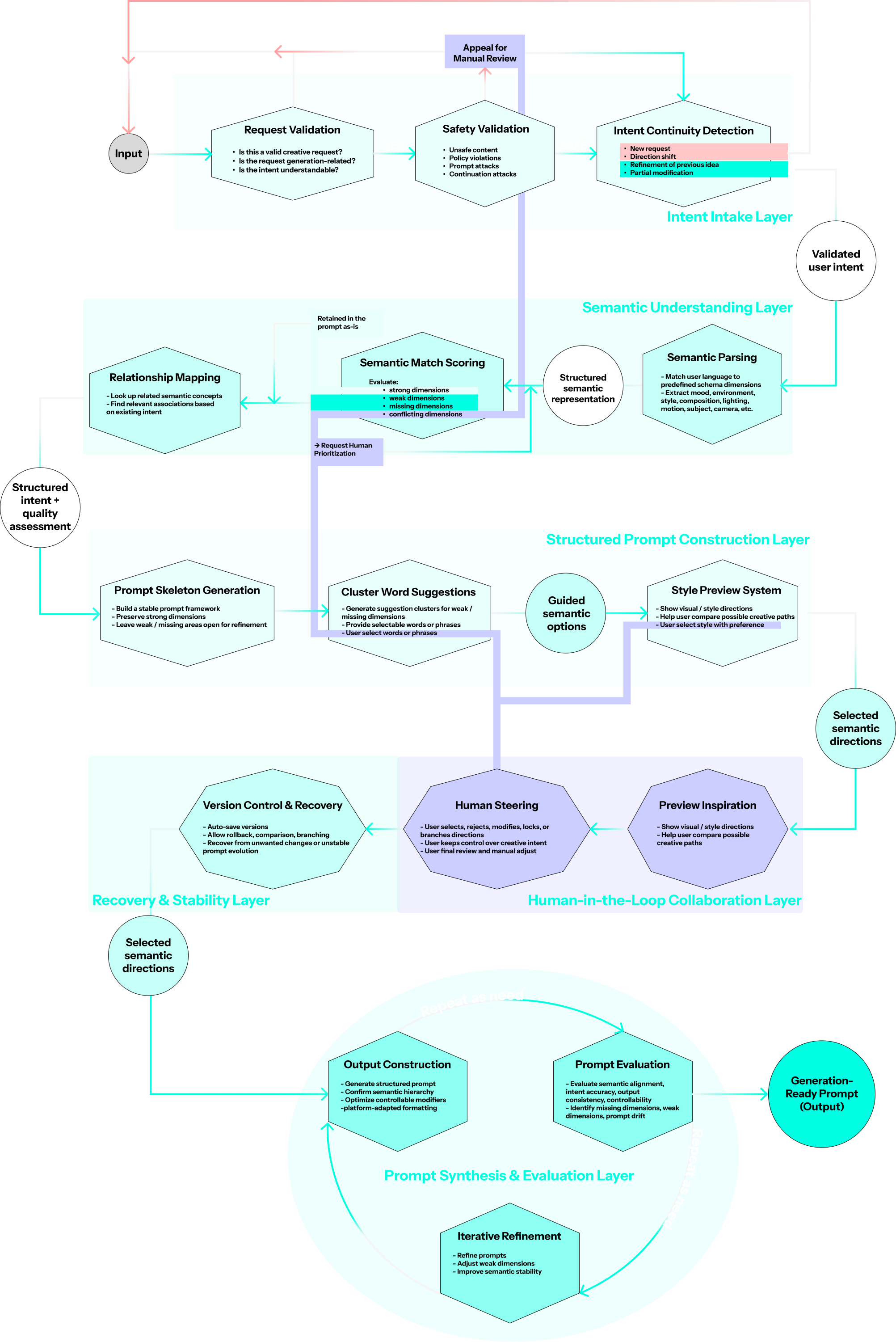
AIONE is designed as a multi-layer intent collaboration system that bridges the gap between human expression and machine interpretation. Rather than generating prompts directly from user input, the system progressively validates, structures, evaluates, and refines intent through a series of specialized layers.
Each layer is responsible for a distinct function—from request validation and semantic understanding to guided prompt construction, human collaboration, recovery mechanisms, and final prompt synthesis. This layered architecture improves reliability, preserves user intent, and ensures that AI assistance remains transparent, controllable, and aligned with user goals throughout the workflow.
By separating intent understanding, collaboration, and prompt generation into dedicated stages, AIONE shifts prompting from a keyword-expansion process into a structured human-AI collaboration experience.
3. Intelligence & Guidance: How AIONE Understands, Evaluates, and Explains
AIONE evaluates each semantic dimension independently. Strong dimensions are preserved, weak dimensions are clarified through refinement options, and missing dimensions become opportunities for guided exploration. This allows users to expand intent without losing what they originally meant.
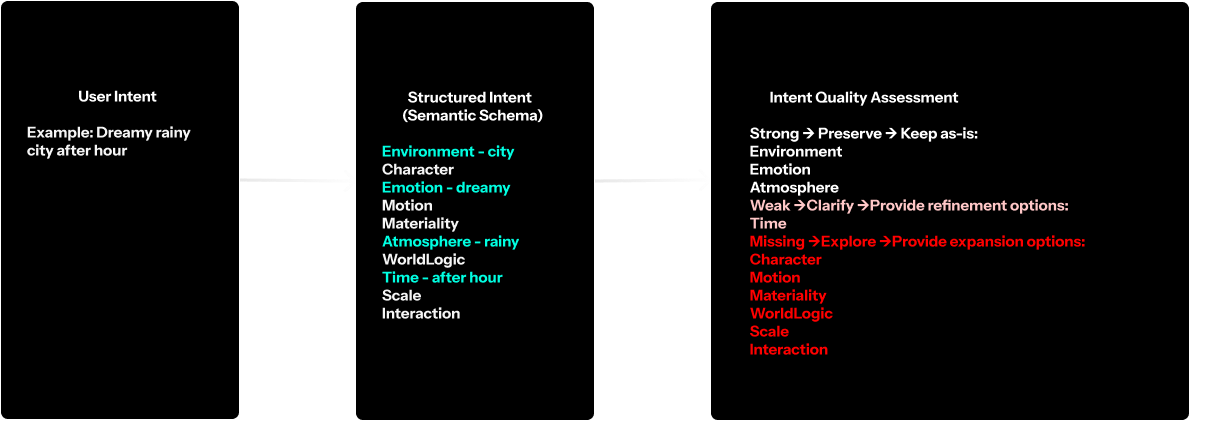
One of the core challenges in AI creation is balancing user intent with prompt quality. Users often know what they want, but may not know how to express it clearly, completely, or using terminology that AI models can reliably interpret.
To address this, AIONE introduces an intelligence and guidance workflow before prompt generation begins.
After receiving user input, AIONE first maps intent into a structured semantic schema composed of dimensions such as emotion, environment, motion, world logic, materiality, scale, and interaction. Each dimension is then evaluated independently and classified as Strong, Weak, or Missing.
Strong dimensions are preserved to protect the user's original intent. Weak dimensions trigger refinement recommendations to help users clarify ambiguous ideas. Missing dimensions become opportunities for guided exploration, allowing users to discover creative directions they may not have considered.
Rather than automatically deciding on behalf of users, AIONE presents contextual options and keeps decision-making visible and controllable. Users can select, modify, ignore, or combine recommendations based on their goals.
As semantic directions are selected, AIONE generates visual vibe-matching references and related semantic tags to help users evaluate ideas through both language and imagery. This creates a more intuitive bridge between abstract intent and concrete creative outcomes.
The process is intentionally iterative. Users can compare alternatives, branch into different creative directions, save versions, test generated outputs, and return to previous states at any time. Manual refinement remains available throughout the workflow, ensuring that AI guidance enhances rather than replaces human judgment.

From a product design perspective, AIONE transforms prompting from a keyword expansion task into a collaborative decision-making process. The system combines explainability, human-in-the-loop interaction, visual guidance, version control, and controllable AI assistance to help users progressively refine intent while maintaining ownership of the final outcome.
4. Human-in-the-Loop: Designing for Human Control
Many AI tools attempt to automate creativity.
AIONE takes a different approach.The goal is not to replace human decision-making, but to help users express, refine, and preserve their intent throughout the creative process.
Human input serves as the starting point of every workflow. Rather than generating prompts independently, AIONE continuously incorporates user decisions through semantic selections, refinement choices, vibe exploration, version comparisons, and manual editing.
At every stage, users can accept, modify, ignore, or replace AI recommendations. Strong intent signals are preserved, while weak or missing dimensions become opportunities for guided exploration rather than automated decisions. Users remain responsible for selecting directions, evaluating alternatives, and determining which ideas best reflect their goals.
Visual vibe matching further supports this process by helping users evaluate concepts through imagery rather than language alone. Users can move back and forth between exploration and refinement, compare different versions, and make precise adjustments whenever needed.
The system evaluates, guides, and explains, but creative ownership always remains with the user. AI acts as a collaborative partner, while humans retain authority over both the process and the final outcome.
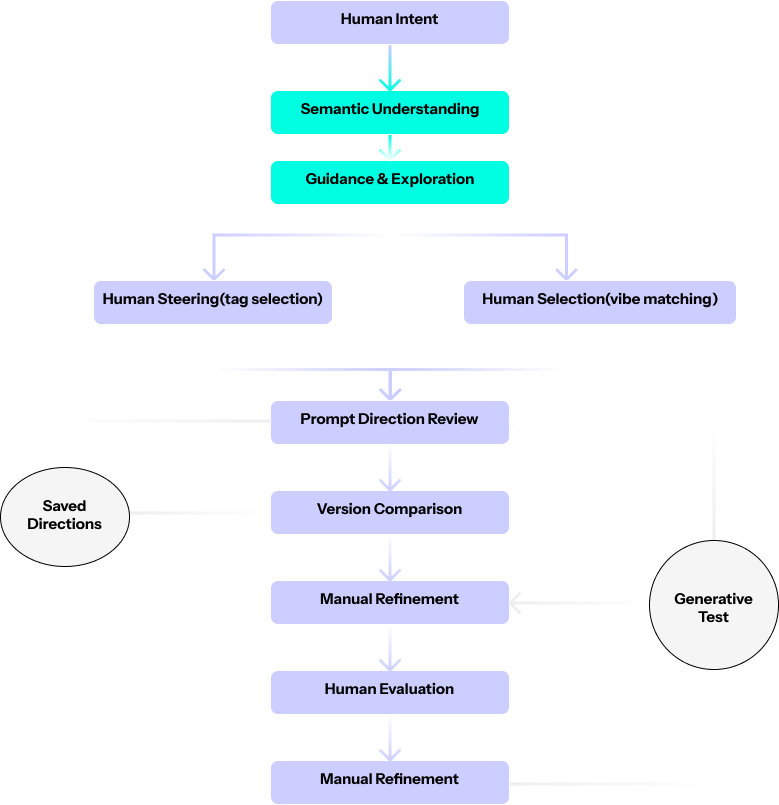
Human intent drives every stage of the workflow. Rather than automating creative decisions, AIONE supports users through semantic guidance, vibe exploration, version management, testing, and refinement. AI helps users explore possibilities, while humans remain responsible for direction, judgment, and final outcomes.
5. Safety & Recovery: Designing for Failure and Stability
AI systems rarely fail in a single way. Beyond safety violations, failures can also emerge from ambiguous intent, poor user-system alignment, or iterative creative exploration. AIONE treats failure as an expected part of the workflow and provides dedicated detection and recovery mechanisms for different failure scenarios.
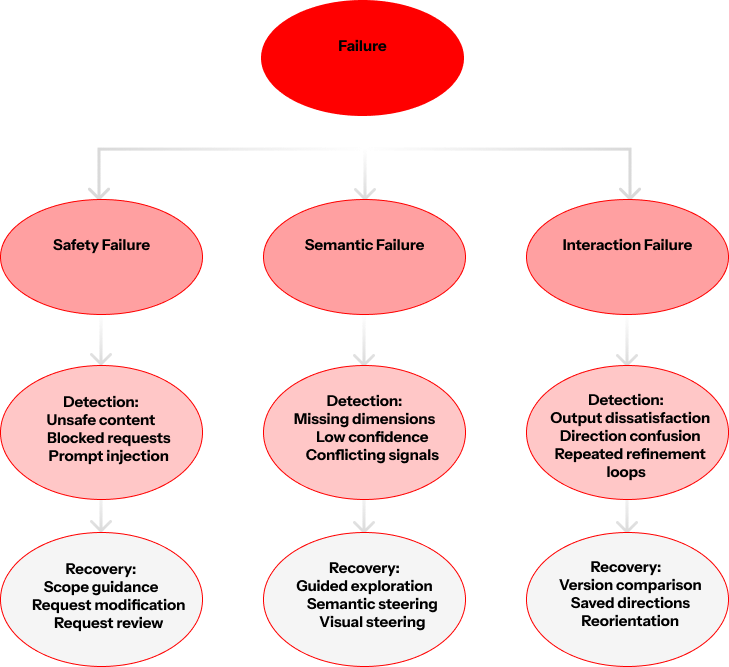
Failure Detection & Recovery Framework
Trust is built not only through successful outcomes, but through predictable behavior when things go wrong. AIONE emphasizes transparency, recoverability, and user control to create a more reliable human-AI collaboration experience.
6. Designing Human-AI Systems: Principles Learned from AIONE
Designing AIONE was not only an exercise in prompt creation. It became an exploration of how humans and AI should collaborate when goals are ambiguous, intent is difficult to express, and outcomes are inherently uncertain.
Principle 1 - Intent Before Output
Traditional software is designed to execute commands. AI systems must first understand intent.
Throughout this project, I found that generation quality was rarely the primary bottleneck. Users often knew what they wanted, but struggled to communicate it in a form that AI could reliably interpret. Designing for intent clarity—through semantic understanding, evaluation, and guided refinement—often created more value than improving generation itself.
This realization became the foundation of AIONE.
Principle 2 - Guidance Before Automation
Many AI products focus on automating decisions. AIONE explores a different direction.
The role of AI is not simply to generate answers, but to help users make better decisions with greater confidence.
Rather than replacing human judgment, the system surfaces possibilities, explains tradeoffs, reduces uncertainty, and helps users navigate complex choices.
In creative workflows, guidance often produces better outcomes than automation because users remain connected to both the process and the result.
Principle 3 - Reliability Before Intelligence
Powerful AI is not automatically trustworthy. Users trust systems that are understandable, controllable, and recoverable.
This led to a strong focus on explainability, failure handling, version control, and human override mechanisms throughout the workflow.
Reliability is not a secondary concern that follows intelligence. It is a prerequisite for meaningful human-AI collaboration.
Principle 4 - AI Products Shape Decisions
Traditional software primarily helps users complete tasks. AI products increasingly influence how users think, decide, and act.
This changes the role of product design.
Designers are no longer only creating interfaces; they are designing decision environments.
Recommendations, suggestions, defaults, exploration paths, and agent behaviors can subtly shape user choices. As AI systems become more proactive and agentic, product design carries greater responsibility for transparency, user agency, and outcome quality.
The challenge is not simply building systems that can act.
The challenge is building systems that help people make better decisions while preserving ownership of those decisions.